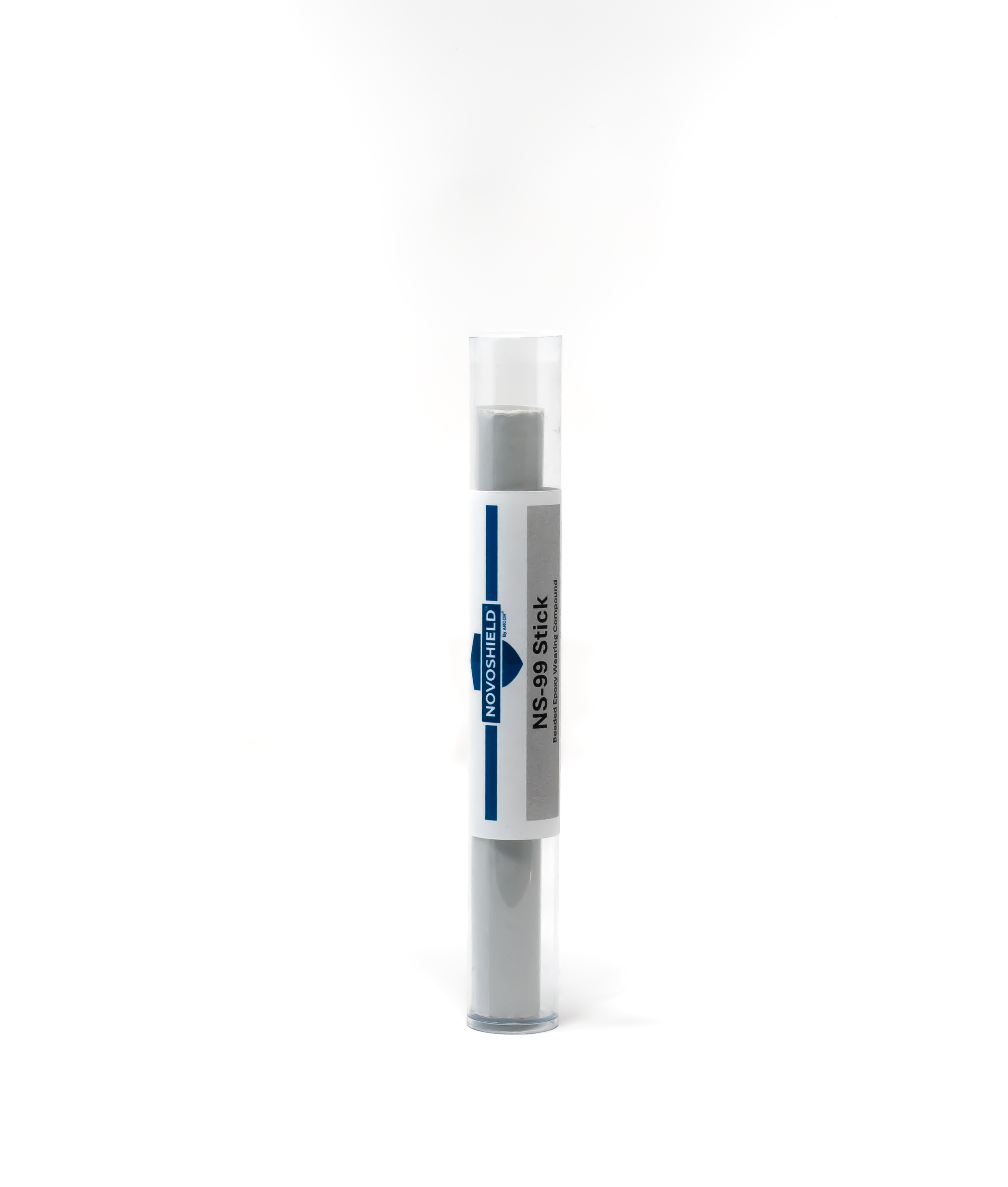
NS-99 Stick 7"
Two-component epoxy stick for emergency repairs — no mixing tools needed, sets in 5 minutes.
Item Numbers
| Color | Kit Size | Product Code |
|---|---|---|
| White | 7" | 726564.03.57 |
General
- Type: Amine Cured 100% Solids Epoxy — Rapid Cure Rebuilding Compound (Stick Form)
- Color: White (when mixed)
- Mix Ratio: 1:1 by volume — no measuring required; knead by hand
- Viscosity: Putty
- Solids by Volume: 100%
- Weight per Gallon: 13.3 lbs (6.0 kg) — 7" stick = 4 oz (120 g)
- Pot Life: 5 min/100 g at 72°F (22°C)
- Work Life: 3 to 5 minutes after mixing
- Sets in: 5 minutes — full service within 1 hour
- Shelf Life: 2 years at 55°F – 95°F (13°C – 35°C)
Temperature Resistance
- Dry service: Max 250°F (121°C)
- Dry spike: Up to 450°F (232°C)
- Temperature resistance varies with chemical exposure — consult Novoshield for immersion service.
Mechanical Properties
- Abrasion: Excellent
- Flexibility: Fair. Excellent with Polyester or Fiberglass Cloth.
- Can be sanded, drilled, tapped, filed, and machined after cure.
- Can be painted with epoxy, urethane, or acrylic topcoats.
Chemical Resistance
- Water: Excellent
- Alkalis: Excellent
- Hydrocarbons: Excellent
- Alcohols, Ketones: Excellent
- Dilute Acids: Good
Bonds To
All metals, concrete, wood, ceramics, glass, and many plastics. Can be applied and cured underwater.
Certifications
Certified to NSF/ANSI Standard 61 for use in contact with drinking water.
Typical Applications
- Fill cracks and voids
- Rebuild rust and corrosion damage
- Repair stripped threads
- Repair leaking pipe and duct
- Anchor equipment
- Rebuild small parts
WARNING: See Material Safety Data Sheet (SDS) before handling this product.
Surface Preparation
Steel surfaces should ideally be abrasive blasted with chloride-free abrasive. Grind flat all burrs, weld seams, and sharp edges. Prime fresh blasted ferrous surfaces immediately with S-20 to prevent oxidation.
- Exterior applications: SSPC SP-10 Near White Metal finish
- Immersion applications: SSPC SP-5 White Metal — 4+ mil profile
Concrete surfaces should be degreased if oil or grease contamination is present, then high pressure washed, acid etched, and high pressure washed again until clean and free of all grease, oils, and surface laitance. Abrasive blast existing coatings to clean concrete. Prime as needed with EE-80 or EE-10/10.5.
Mixing
Cut or twist off the required amount. Knead with a gloved hand until the material reaches a uniform color — no measuring required.
If mixing is difficult, warm the stick to room temperature (72°F) or slightly above. A 7" stick unit can be warmed in a microwave for 10–15 seconds if needed.
Never thin this product.
Application
Apply to the surface within 2 minutes of mixing. Force the material into any cracks or holes and strike off excess, preferably with a tool moistened with clean water or Acetone.
- When applying to a damp, wet, or slowly leaking surface, work the material forcefully into the surface and apply pressure until adhesion takes effect.
- For best results, use damp nitrile gloved fingers for easier mixing, application, and a smoother finish.
- Remove excess material before hardening begins — work life is 3 to 5 minutes.
Application Temperature
- Material: 55°F – 95°F (17°C – 35°C)
- Substrate: 45°F – 105°F (7°C – 40°C)
- Max temp differential between material and substrate: 10°F (5°C)
- Dew point: Substrate must be minimum 5°F (3°C) above dew point
- Max relative humidity: 90%
Do not use gas, oil, or kerosene heaters — these leave residue on metal surfaces that will compromise adhesion. Use electric heaters or heat lamps only.
Overcoat & Cure Times (at 77°F / 25°C)
- Brush, roller, or squeegee recoat window: 1 to 2 hours (while still soft but tack-free)
- Spray recoat window: 2 to 12 hours
- Full cure before immersion: 72 hours at 77°F — add 1 hour per 10°F below 77°F
- Force cure (aggressive environments): 8 hours at 150°F (66°C), or 2 hours at 250°F (121°C)
If the overcoat window is exceeded, abrade the surface with coarse sandpaper, a grinder, or brush blast, then wipe with MEK or Acetone before recoating.
Clean Up
Clean tools immediately after use.
- Standard: M.E.K., Acetone, or similar
- Solvent-controlled environments: 98%+ Isopropyl Alcohol
Manufacturer makes no warranty either expressed or implied including warranties of merchantability or fitness for a particular purpose for this product. The information contained herein is provided in good faith and believed to be true and accurate. Contact our technical team for specific application guidance.